Your AI is Only as Smart as the Network Context You Give it
Ask an AI to help troubleshoot a voice quality complaint on your network. You’ll get an answer fast: check QoS policies, verify DSCP markings, review interface drops, and look at...

As a network operations manager or leader, you are responsible for the changes that drive success. One critical change to consider is switching from manual network management to automated management.
Automation offers a solution for streamlining workflows and overcoming pain points. This transformative approach automates routine processes, enhances efficiency, and reduces business risks. From automated troubleshooting to real-time performance monitoring, network automation delivers peace of mind, helps organizations maintain compliance, and promotes resource optimization.
Network automation eliminates the need for manual network management. An intelligent network automation tool identifies efficient ways to manage, provision, configure, and map a network. Modern automation platforms deliver additional capabilities, such as provisioning and verifying a network’s ability to handle a configuration before a team implements it. Other sophisticated forms can use machine learning (ML) to identify opportunities for optimization.
Key features of network automation include:
Manual network management no longer meets the fast-paced demands of modern needs. Human intervention poses several obstacles for network leaders, including insufficient network insight, unknown risks during changes, slow incident response, and poor documentation.
1. Insufficient Network Insight
Manual processes offer limited visibility into network operations, which hinders effective troubleshooting and informed decision-making. Traditional methods lack centralized monitoring and analytic capabilities. Along with limiting insights, manual operations can result in lengthy troubleshooting processes. Insufficient tools and information can result in prolonged periods of attempting to address network problems, leading to lower efficiencies and higher operational costs.
These pain points also impact business continuity. Frequent periods of downtime, errors, and slow manual troubleshooting can disrupt operations. Teams may be unable to perform critical tasks, ultimately hindering operations and affecting customer satisfaction.
2. Unknown Risks of Network Change
Manual network changes pose several significant risks, which can lead to security vulnerabilities and outages. Configuration errors due to incorrect IP addresses, mismatched protocols and similar mistakes can propagate across networks.
Manual tasks can also introduce security gaps inadvertently. For example, misconfiguring firewalls or leaving ports open can have devastating security consequences. Additionally, it can be challenging to understand how one network change can impact interconnected services and devices without monitoring mechanisms.
Automation mitigates these risks by stimulating changes in a controlled environment, ensuring consistent and compliant configurations, and employing real-time monitoring to detect issues and alert teams immediately. Network security automation allows teams to identify potential pain points before deployment and can provide insights for addressing concerns. Some solutions also offer rollback mechanisms, which can be used to revert to stable states in the event of a failure.

3. Slow Incident Response
One of the most significant challenges of manual network management is slow incident response. Manual troubleshooting processes result in prolonged downtime and can be inconsistent. Slow responses to update deployment, threats, and new business requirements can hinder business innovation and growth.
Implementing automation in network security allows teams to quickly identify network threats and reduce implementation periods. Automation reduces delays and minimizes network downtimes to support fast and consistent recovery.
4. Scarce Network Documentation
Maintaining accurate documentation when relying on manual management can feel impossible. Manual processes require staff knowledge and actions, which can result in teams losing valuable information if key personnel leave. Additionally, if a team member forgets to document information or makes a recording error, your team will be relying on incomplete or inaccurate data.
Even with consistency, errors are more likely to occur from manual practices. Modern networks are dynamic, complex environments. Devices and configurations often undergo frequent updates and changes. Keeping a record of all changes, updates, additions, and removals can be challenging and prone to oversight, especially in complex or large networks. These inefficient or incomplete processes ultimately impact knowledge transfers and troubleshooting efficiency.
Automation addresses these concerns and challenges by employing real-time updates, centralizing repositories, and leaving audit trails. Teams can configure automated systems to adhere to standardized processes, ensuring consistency across practices and formats.
Network automation is now a strategic priority for IT leadership.
For network leaders, the question isn’t whether to automate but rather how to do it in a way that’s scalable and secure.
Organizations need to embrace new approaches and technologies to remain competitive and drive business growth. The following trends reflect a shift toward smarter, more secure networks that support digital transformation:
Through network automation, teams can overcome the challenges manual management presents. Automation also offers several additional advantages for leaders, including enhanced network performance monitoring, cost reduction, increased digital headcount, and improved compliance.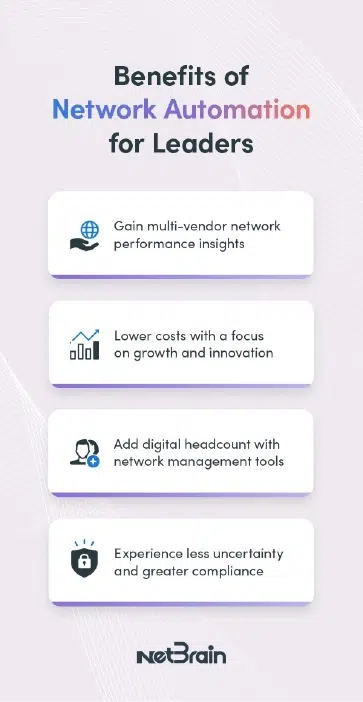
Check out these benefits of network automation:
1. Gain Multi-Vendor Network Performance Insights
Automation facilitates centralized monitoring and reporting across vendors. Here is how automation informs your network performance:
2. Lower Costs With a Focus on Growth and Innovation
Network automation supports reducing operational expenses and promoting better resource utilization to support growth.
3. Add Digital Headcount With Network Management Tools
Automation tools supplement existing teams by handling repetitive tasks and managing larger networks. This virtual workforce helps in scaling operations, reducing human resource reliance, and boosting overall efficiency.
4. Experience Less Uncertainty and Greater Compliance

Without automation, businesses must rely on staff knowledge, configuration, access controls, and updates. These processes can be time-consuming and error-prone, which can result in several adverse business outcomes.
Comparatively, network automation helps businesses maintain compliance by supporting documentation, eliminating errors, and enforcing policies.
Successful network automation implementation requires adhering to best practices to maximize efficiency and promote long-term scalability. Check out these tips for implementing automation:
Finding the right network automation solution is essential for maintaining a competitive edge, meeting compliance, and promoting business growth. NetBrain is revolutionizing network automation through no-code automation solutions that address various network management challenges.
With NetBrain, you can find capabilities for:
Network Visibility
NetBrain enhances network visibility by delivering intuitive insights for troubleshooting and threat detection. You can monitor performance across platforms and secure multi-vendor networks in minutes. Our platform safeguards systems while maintaining vendor trust and confidence. With real-time application pathing, you can discover deviations, monitor path performance and connectivity, reduce downtime, and assess app health in a summary dashboard.
Network Troubleshooting
Our automated troubleshooting solutions simplify threat identification and incident response. Our technology allows you to conduct automated monitoring, summarize data efficiently, and quickly remediate network problems. You can enable machine auto-diagnosis and implement diagnostic tools to streamline troubleshooting.
Network Assessment
Continuous assessment enables teams to prevent service disruptions after outages, cyberattacks, or network changes. With NetBrain, you can find monitoring solutions to maintain efficient network operations. Use observability dashboards to gain insights on application performance, compliance, security, and network health, all in one place.
Network automation is crucial for improved efficiency, accuracy, and cost savings, but you need to find a suitable solution to optimize your investment. NetBrain is ready to revolutionize your network operations.
Our software for network leaders reduces downtime, enhances visibility, improves compliance, and allows for informed decision-making. Start a live chat today to learn more about our capabilities.
